ISSN: 2519-2353
Unified State Register of Enterprises and Organizations of Ukraine: 43814498
Scientific peer-reviewed journal with open access (category "B").
The founders of the publication: LIMITED LIABILITY COMPANY SCIENTIFIC ORGANIZATION HORIZONT LAW (LLC SCIENTIFIC ORGANIZATION HORIZONT LAW).
ESS Press is the manager of a journal (Poland).
Certificate of state registration of printed media: NO. 25388-15328 ПР
Entity identifier in the field of online media of Ukraine: R40-06690
Entity identifier in the field of printed media of Ukraine: R30-06675
Year of foundation: 2008
Issue frequency: 4 times a year
Language of publication: English
DOI: https://doi.org/10.54477/LH.25192353
Vol. 29 No. 2 (2026): LEGAL HORIZONS
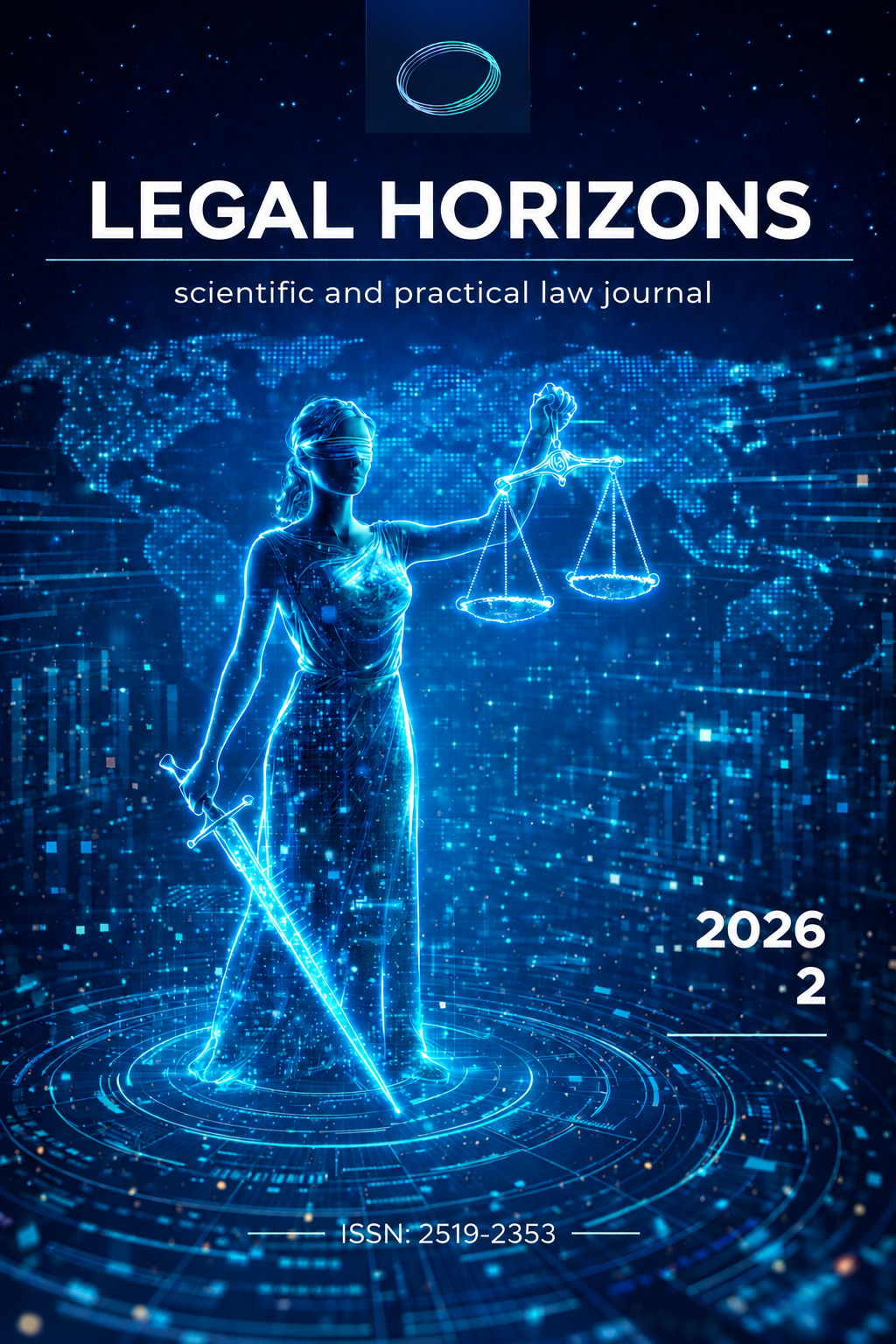
The Editorial Board is pleased to present Volume 29, Issue 2 (2026) of LEGAL HORIZONS, an issue that reflects the growing complexity of contemporary legal systems and the increasing interconnection between national, regional, and international legal orders. The contributions assembled in this issue address a broad spectrum of legal challenges arising from economic transformation, technological innovation, armed conflict, environmental protection, migration, religious security, and the evolution of legal institutions. Collectively, they demonstrate how legal scholarship continues to respond to rapidly changing social realities while advancing theoretical understanding and practical solutions.
The issue opens with "Peculiarities of detecting criminal offences in the sphere of economic Activity," in which Bozhyk examines contemporary approaches to detecting and investigating economic crimes. The article analyzes procedural, evidentiary, and organizational aspects that influence the effectiveness of criminal justice mechanisms in combating increasingly sophisticated financial misconduct.
Issues of international and regional security are further explored in "Legal support for countering the cross-border spread of religious extremism: The experience of Central Asian states," where Zhetpissov and Yerbolatov analyze the legal frameworks adopted by Central Asian countries to address the transnational spread of religious extremism. Their comparative study highlights the importance of regional cooperation, harmonized legal regulation, and compliance with international human rights standards in responding to cross-border security threats.
Historical legal development remains an important source of understanding for modern jurisprudence. In "Ecclesiastical judiciary during the period of the Hetman state," Hryhorchuk, Shevchenko, and Honcharov examine the institutional organization, jurisdictional principles, and interaction between ecclesiastical and secular courts during one of the formative periods of Ukrainian statehood. Their research enriches contemporary legal history by shedding light on the evolution of judicial institutions.
The consequences of armed conflict and the search for effective remedies are addressed in "International compensation models for compensation for damage caused by armed aggression as tools for the protection of human rights," where Shevchenko and Badakhov evaluate existing international compensation mechanisms designed to provide redress for victims of armed aggression. The authors assess the strengths and limitations of these models and consider their role in strengthening accountability and protecting fundamental human rights.
Migration governance and national security form the focus of "Migration policy in the context of national and religious security: A comparative legal analysis of the Kazakhstan model and international experience." In this contribution, Shagieva and Bexultanov compare Kazakhstan's migration framework with international legal standards and foreign practices, offering valuable insights into balancing migration management, security concerns, and the protection of individual rights.
The challenges of financial innovation are examined in "Regulatory arbitrage in european union digital finance: development dynamics and Implementation Risks," where Voievodina explores how regulatory arbitrage develops within the European Union's digital financial ecosystem. The article discusses the opportunities and risks associated with regulatory divergence while emphasizing the need to preserve market integrity, legal certainty, and effective supervisory oversight.
The issue concludes with "Biological criteria for serious widespread harm in defining ecocide: Operationalizing ecological indicators for the purposes of international criminal law," in which Naboichenko proposes scientifically grounded biological criteria for assessing serious environmental harm within the emerging legal concept of ecocide. By integrating ecological indicators into legal analysis, the study contributes to the ongoing development of international environmental criminal law and strengthens discussions concerning accountability for large-scale environmental destruction.
Taken together, the articles published in this issue illustrate the multidimensional nature of contemporary legal scholarship. They combine doctrinal, comparative, historical, and interdisciplinary perspectives while addressing problems that transcend national borders and require innovative legal responses. The diversity of topics reflects the journal's commitment to promoting research that not only advances legal theory but also informs legislative development, judicial practice, public administration, and international cooperation.
The Editorial Board expresses its sincere gratitude to all authors for their valuable scholarly contributions and to the reviewers whose expertise and commitment to rigorous peer review have ensured the high academic standards of this issue. We also thank our readers for their continued interest in LEGAL HORIZONS and hope that the research presented in this volume will contribute meaningfully to ongoing legal discourse and inspire further academic inquiry into the challenges facing modern legal systems.
Published:
29.06.2026
View All Issues
Editor-in-Chief
ANATOLII Y. SHEVCHENKO
Deputy Editor-in-Chief
JOANNA OSIEJEWICZ
The editorial board of the scientific journal includes well-known Ukrainian and foreign scientists from Italy, Bulgaria, and Kazakhstan. Information about the full staff is available in the section Editorial Board.
All materials are distributed under the terms of the creativecommons.org/licenses/by/4.0, which allows others to redistribute the work with acknowledgment of the authorship of the work and the first publication in this journal.
Open Access Policy. The journal adheres to an Open Access Policy, supporting the principles of free dissemination of scientific information and global exchange of knowledge for the sake of social progress. This means that all of its content is in open access to users for free. For more information, see the Open Access Policy. Full-text access to the scientific articles of the journal is presented in the Archive.
Indexing. Legal Horizons is indexed by international databases and catalogues: