
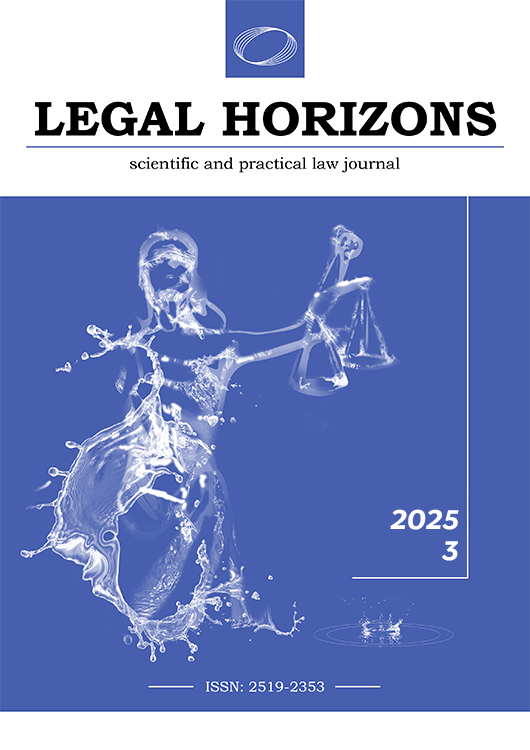
It is with great pleasure that we present Volume 26, Issue 3 of LEGAL HORIZONS, a collection of articles that exemplifies the breadth, depth, and interdisciplinary nature of contemporary legal scholarship. This issue brings together contributions that span comparative law, legal theory, socio-legal studies, and emerging challenges in digital and environmental governance, highlighting the dynamic interaction between law and society in the twenty-first century.
Our issue opens with Anna Petrenko’s “The Dutch experience of implementing restorative justice in criminal proceedings: Prospects for Ukrainian justice”, which examines restorative justice in the Netherlands and offers insights into its potential adaptation within the Ukrainian justice system. This comparative perspective underscores the importance of cross-jurisdictional learning in the pursuit of effective criminal justice reform. Complementing this, Serhii Prylypko’s Organizational and legal mechanisms of the functioning of the social state provides a thorough analysis of the institutional and legal frameworks underpinning the functioning of the social state, while Svitlana Bieliavska’s The concept of property in Roman civil law and its evolution traces the evolution of the concept of property from Roman civil law to its contemporary implications.
Several contributions explore pressing policy and governance challenges. Juwita Manurung, Fadli Moh, Koeswahyono Imam, Permadi Iwan, and Wibisono Anditya Ariest’s The Legal Politics of Agrarian Reform in Jakarta and the Marginalization of Land Cultivators scrutinizes agrarian reform in Jakarta, highlighting the marginalization of land cultivators. Similarly, Rahmah Sherina Azkia, Sihabudin, and Dewantara Reka’s Legal Politics of Investment Screening in Indonesia’s Foreign Investment Reform examines the legal politics of investment screening in Indonesia’s foreign investment reform. Sasmitaningrum Dini, Widhiyanti Hanif Nur, and Anggraini Erna’s Legal Protection for Consumer Buyers of Flats with a Sale and Purchase Agreement Made Under Hand through the Pre Project Selling System addresses consumer protection in real estate transactions, a subject of increasing relevance in rapidly urbanizing contexts.
This issue also engages with the legal and ethical implications of contemporary technological and environmental challenges. Oleksii Shamov’s AI and copyright: From a doctrinal crisis to a hybrid model of collective licensing analyses the intersection of artificial intelligence and copyright law, proposing a hybrid model of collective licensing. Nataliia Stepanenko and Kostiantyn Perepadin’s Ensuring human rights in the context of digital technologies during an armed conflict explores human rights protections amid digital technologies during armed conflict. Viktoriia Sydor and Yuri Ishchenko’s Legal aspects of environmental terrorism in the context of the war in Ukraine: New challenges to global security examines legal responses to environmental terrorism in Ukraine, emphasizing emerging threats to global security. Finally, Olena Kalmykova and Yuliia Vyshnevska’s Administrative and legal support for psychological support and rehabilitation of servicemen of the armed forces of Ukraine provides a detailed study of administrative and legal frameworks supporting the psychological rehabilitation of Ukrainian servicemen, highlighting the critical intersection of law, policy, and human welfare.
Taken together, these contributions reflect the journal’s ongoing commitment to advancing rigorous, policy-relevant, and socially attuned legal scholarship. They illustrate how law operates both as a framework for societal organization and as a tool for addressing contemporary challenges—from restorative justice and agrarian reform to AI, digital rights, and environmental security. We are confident that this issue will provide readers with rich insights, stimulate scholarly debate, and inform practical reforms in legal systems worldwide.
We extend our sincere gratitude to the authors for their outstanding contributions and to our reviewers for their careful and constructive feedback. We hope that Volume 26, Issue 3 of Legal Horizons will inspire further research, dialogue, and innovation across the global legal community.
— Editorial Board, LEGAL HORIZONS
Published: 29.08.2025